
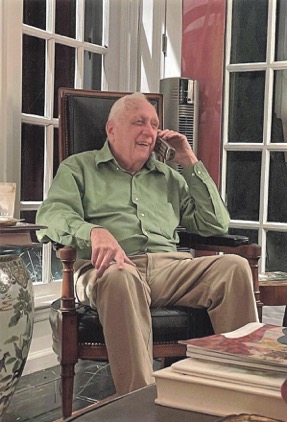
Ray Pierotti was born in Bountiful, Utah, but it would be inaccurate to say he ever belonged to just one place. From an early age, his life unfolded across landscapes—geographic, cultural, and intellectual—that stretched far beyond his birthplace. He traveled extensively throughout the United States, wandered through the artistic corridors of Europe, and immersed himself in the layered traditions of the Far East. Each journey left an imprint, not just on his memory, but on the way he would come to see—and ultimately translate—the world.
Pierotti’s thinking developed at the intersection of science and spirituality. Grounded in the tangible principles of wave and particle physics, he simultaneously found himself drawn toward mysticism and the philosophical traditions of both East and West. Rather than seeing these domains as contradictory, he experienced them as complementary languages describing the same truths. Over time, this duality evolved into a personal visual language—one that sought to reconcile the measurable and the immeasurable.
“I am drawn to the ephemeral nature of light,” he once said. “The source of both the external and internalized appearances of color in materialized space.” For Pierotti, light was not merely a physical phenomenon but a bridge—connecting perception and memory, the outer world and the inner one. In his mind, remembered scenes and imagined ones blended seamlessly, much like sensory fragments—smells, tastes, textures—intertwining to form the emotional fabric of lived experience.
Though academically he might be labeled “self-taught” in painting, Pierotti himself rejects that notion. His true teachers, he insists, were not confined to classrooms. They were found in the countless museums he wandered through, the cathedrals that stirred something wordless within him, the performances that reshaped his understanding of rhythm and movement, and the libraries that opened doors to both ancient and contemporary thought. Equally influential were the people he encountered along the way—artists, thinkers, and everyday individuals whose perspectives quietly expanded his own.
Despite developing a distinct and recognizable style, Pierotti has always resisted being categorized. Labels, in his view, impose limitations that run counter to the very essence of artistic exploration. What remains consistent in his work is not a style, but a method—an ongoing pursuit of multi-layered transparency. His paintings are built gradually, through the application of multiple mediums on untreated natural surfaces. Each layer contributes to a sense of depth that is not just visual, but experiential.
In this process, Pierotti often draws inspiration from unexpected sources. One such influence is the ancient Chinese philosopher Lao Tzu, whose writings resonate deeply with his worldview. A particular line lingers with him: “…whether a man dispassionately sees to the core of life or passionately sees the surface, the core and the surface are essentially the same…” For Pierotti, this idea reflects a central truth—that what we perceive as divisions are often illusions created by language and perspective.
This belief extends into his critique of contemporary society’s relationship with the arts. He argues that art has been reduced to mere decoration, a superficial layer applied to life rather than an integral part of it. In doing so, society has overlooked the deeper role art can play in shaping human understanding. To Pierotti, art is not an accessory—it is essential. It belongs at the center of intellectual, emotional, and spiritual development, woven into the very fabric of how we learn and grow.
He sees science as having, in some ways, narrowed our perception—encouraging us to think in binaries, in “either/or” frameworks. While invaluable in its own domain, this mode of thinking can limit our ability to perceive the infinite. Art, by contrast, offers a different pathway. It bypasses rigid structures and speaks directly to what he calls the “heart’s intelligence”—a realm where meaning is fluid, expansive, and unified.
This philosophy is embodied in his paintings. Like a musician coaxing sound from an instrument, Pierotti engages with his materials in a way that acknowledges their inherent qualities. The surface, the pigment, the texture—all play an active role in the final work. Nothing is incidental. The artist and the medium become inseparable, each shaping the other.
The result is a body of work that mirrors the process of human individuation itself. Physical, emotional, intellectual, and spiritual dimensions are not treated as separate layers but as interwoven aspects of a single unfolding experience. In this way, Pierotti’s art becomes more than visual—it becomes a reflection of life’s complexity, its unity, and its quiet, persistent search for meaning.
Brief Chronology
1932 - 1963Foundations in Art, Music, and Global Experience
Born in Bountiful, Utah and educated in the Davis County public schools, Pierotti evidenced, early in life, musical and visual artistic gifts. Following graduation from High School he entered the military and served two years in Korea and Japan. The experience informed his early artistic sensibilities. Following the service he moved to France where he served a 2 year mission for the LDS church and later worked at the American Library in Paris and completed his first undergraduate degree at La Sorbonne after which he returned to his native Utah and completed a BFA and MM at the University of Utah in musicology and music composition.
1963 - 1977New York Years and Emergence as a Professional Artist
Moved to New York City where he supported his career as a painter by teaching at the New York School of Visual Arts, later as Assistant Director of the American Craft Museum and Director of national programs for the American Craft Council. Had his first solo exhibitions in New York’s Sawdust Gallery followed by exhibitions at the South Carolina Museum of Art, the Hunter Museum of Art, the Fine Arts Museum at the University of Idaho plus inclusion in numerous group shows throughout the USA.
1977 - 1987Leadership, Teaching, and National Recognition
Accepted the directorship of The Arrowmont School, coupled with an associate professorship at the University of Tennessee, Knoxville. His exhibition schedule included the University of the South, Fairfax Art Academy, Morristown Art Center and numerous solo exhibitions in private galleries. Appointed as Chair of the Dept. of Fine and Performing Arts at SCCC he moved to Michigan. He was later invited to open up and direct the Sawtooth School of Visual Arts in Winston-Salem with solo exhibitions at the Southeastern Center for Contemporary Art, the Greenhill Center for the Arts along with additional solo and group exhibitions throughout the Southeast US.
1987 - 2014Mature Career, Institutional Impact, and Creative Expansion
Invited to re-open the Hambidge Center for Creative Arts in North Georgia and later asked to direct The International Museum of Art & Design (now called MODA), he moved his studio to Atlanta while working in North Georgia during the Spring and Summer months. He began painting in Shellman in the early 90’s in the barn studio. His list of solo exhibitions in private galleries and museums along with corporate and public commissions has led to a successful career as an independent studio artist. With his life partner, Gene Lewis opened the Center for Art and Rehabilitative Energies, Inc. a 501 (c)(3) private foundation. Each year he leads 2–3 hands-on workshops in his unique artistic technique. He currently lives and works in Shellman. Completed 2 Art in Public Places Commission (NC & GA).2015 - 2019Exhibitions, Awards, and Continued Influence
Recent Solo exhibition at Albany Museum of Art, GA, “Continuous Threads” Buford, GA, Included in “Summer Sizzle”, AAAC, GA. Taught workshops: Fiber Forum, Arrowmont, Gatlinburg, TN, and at IMAVG, Durango, CO. Awarded 1st in GAGA Invitational ’15 and 2nd in Southeastern Regional ’16. Curated 18 exhibitions (2012–16) for the Center for Art & Rehabilitative Energies, Inc. Completed public and private commissions in Shellman studio. He serves on the Albany Area Arts Council Board, on the Georgia Council for the Arts Grant Panel and The Surface Design International Grant’s Panel.2020 - NOWOngoing Exhibitions and Artistic Presence
Albany State University Gallery. Albany Museum of Art. GAGA.